Rainwater harvesting
Thousands of gallons of clean, free water land on your roof every year and run straight down the storm drain. Collecting some of it is cheap, simple, and legal in most states. Run the calculator below before you do anything else; the number it gives you is usually what convinces people. Here in Florida the math gets absurd in summer, when one afternoon thunderstorm can fill a barrel from a single downspout.
Start here

Andrew Millison — An Oregon State permaculture instructor walks through how roof catchment actually works, from gutters to storage to use.
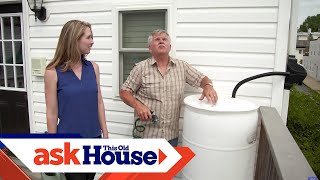
This Old House — A full single-barrel build with exact fittings and cuts. This is the project at the bottom of this page, on video.

Brad Lancaster — Lancaster runs his Tucson household on harvested rain in a 12-inch rainfall climate. The big-picture case, from the person who wrote the books on it.
First project
Single rain barrel
Before building anything, calculate your roof's actual potential. Then install one barrel on your most accessible downspout and use it for garden irrigation all season.
You need: a 55-gallon food-grade barrel (check Craigslist or Facebook Marketplace, often free or $10 from a car wash), a downspout diverter kit (~$15 at any hardware store), a 3/4" spigot, an overflow hose, and about two hours. The diverter is the only specialty part; everything else is standard plumbing fittings. Check your county's rules first. Florida has no restrictions, but a few states still require a permit.
Catchment calculator
Tampa avg. rainfall: 52 inches. Formula assumes 85% collection efficiency and 0.623 gal/sq ft/inch.
Other ways in
One-week household water audit
Before storing water, learn where it goes. For seven days, log every significant water use in the house: shower minutes, dishwasher loads, laundry loads, toilet flushes, outdoor irrigation. Cross-check against your utility meter at the start and end of the week. You will end up with a per-capita gallons-per-day baseline that makes every later sizing decision honest.
Drip irrigation kit on an existing hose bib
Buy a $25 drip kit and run it from an outdoor spigot to one garden bed or row of containers. Learn emitter sizing, pressure regulation, and the dramatic reduction in water use compared to a sprinkler or hand-watering. The plumbing skills transfer directly to any later rainwater distribution system.
Once you've run a barrel for a season and learned how fast it fills (and how much faster it empties), the next step is a 275-gallon IBC tote system with a first-flush diverter and basic filtration. See water in phase 2 →
Go deeper
Community Experiences
Loading...